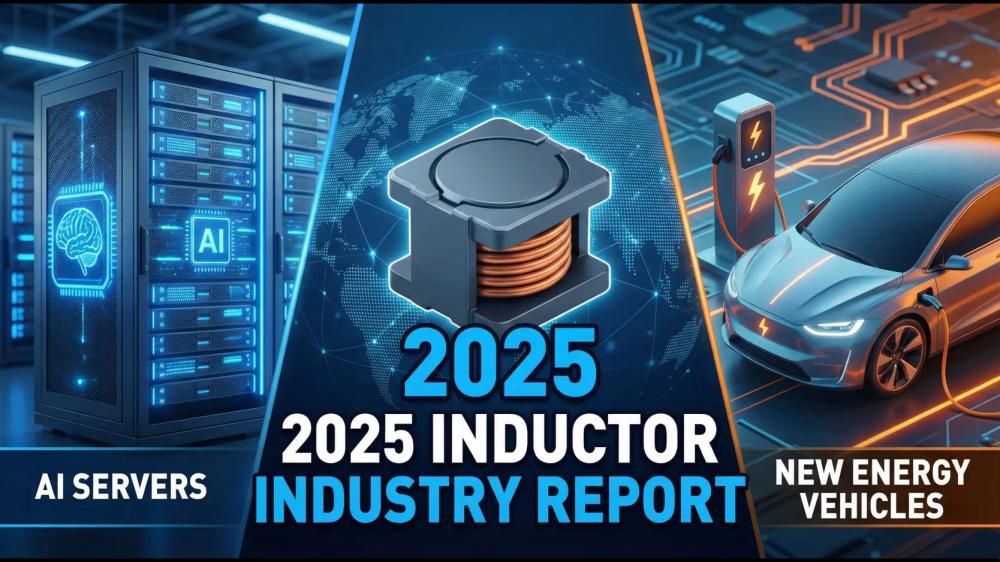
2025 Inductor Industry Research Report
Executive Summary
This report provides a comprehensive analysis of the global inductor industry in 2025, covering market size, growth drivers, competitive landscape, technology trends, and investment recommendations.
1. Market Overview
1.1 Global Market Size
| Metric | Value |
|---|---|
| 2025 Global Market Size | RMB 78-80 billion (approximately USD 11 billion) |
| Compound Annual Growth Rate (CAGR) | 3-5% |
| 2030 Projected Market Size | ~USD 15.8 billion |
The global inductor market continues to demonstrate steady growth, driven by the proliferation of electronic devices and the advancement of emerging technologies. The market is expected to maintain a healthy growth trajectory through 2030.
2. Key Growth Drivers
2.1 New Energy Vehicles (NEV)
- Inductor Usage per Vehicle: 100-200 units
- Segment CAGR: 10-12%
- Key Applications:
- On-board chargers (OBC)
- DC-DC converters
- Battery Management Systems (BMS)
- Electric drive systems
The rapid adoption of electric vehicles globally has created substantial demand for automotive-grade inductors, particularly high-power inductors capable of withstanding harsh operating conditions.
2.2 AI Servers
- Inductor Usage: 3-5x that of traditional servers
- Segment CAGR: 15%+
- Key Applications:
- GPU power delivery
- High-current voltage regulators
- Data center power management
The explosive growth of artificial intelligence and large language models has driven unprecedented demand for high-performance computing infrastructure, significantly boosting the demand for high-current, high-efficiency power inductors.
2.3 5G Communications
- Applications: Base stations, small cells, network infrastructure
- Requirements: High-frequency inductors, RF inductors, miniaturized components
2.4 Consumer Electronics
- Applications: Smartphones, tablets, wearables, IoT devices
- Trend: Continued demand for ultra-miniaturized inductors
3. Competitive Landscape
3.1 International Leaders
| Company | Headquarters | Core Competencies |
|---|---|---|
| TDK Corporation | Japan | Advanced materials, high-frequency inductors |
| Murata Manufacturing | Japan | Multilayer chip inductors, miniaturization technology |
| Taiyo Yuden | Japan | High-Q inductors, automotive-grade products |
These international players maintain technological leadership in high-end inductor segments, particularly in automotive and high-frequency applications.
3.2 Chinese Domestic Manufacturers
| Company | Stock Code | Focus Areas |
|---|---|---|
| Sunlord Electronics | 002138.SZ | Power inductors, automotive inductors |
| Microgate Technology | 300319.SZ | Integrated inductors, RF components |
| Fenghua Advanced Technology | 000636.SZ | MLCC, chip inductors |
Chinese manufacturers are accelerating their catch-up efforts through:
- Increased R&D investment
- Capacity expansion
- Strategic focus on domestic substitution
4. Technology Trends
4.1 Miniaturization
- Current Frontier: 006003 form factor (0.6mm × 0.3mm)
- Drivers: Smartphone thinning, wearable devices, IoT applications
- Challenges: Maintaining inductance and current handling in smaller packages
4.2 High-Frequency Operation
- Target Range: MHz-level switching frequencies
- Applications: High-efficiency power converters, 5G RF circuits
- Key Technologies: Advanced magnetic materials, optimized winding structures
4.3 High-Power Capability
- Current Handling: 100A+ for high-power applications
- Applications: EV powertrains, AI server power delivery
- Solutions: Molded power inductors, metal alloy core materials
4.4 Integration
- Trend: Integrated inductor modules combining multiple functions
- Benefits: Reduced PCB footprint, improved system efficiency
- Examples: Integrated power stages, inductor-capacitor modules
5. Investment Recommendations
5.1 Short-Term Focus (1-2 Years)
AI Server Inductor Demand Surge
- Monitor companies with exposure to data center and AI infrastructure
- Key products: High-current inductors (50A-100A+), low-DCR power inductors
5.2 Medium-Term Focus (3-5 Years)
Automotive-Grade Inductor Domestic Substitution
- Chinese manufacturers gaining automotive certifications (AEC-Q200)
- Opportunities in NEV supply chain localization
- Focus on companies with established automotive customer relationships
5.3 Long-Term Focus (5+ Years)
Materials Self-Sufficiency
- Magnetic materials (ferrite, metal alloy powders)
- Core material independence from foreign suppliers
- Strategic importance for supply chain security
6. Risk Factors
- Geopolitical tensions affecting supply chain stability
- Raw material price volatility (rare earth elements, copper)
- Technology gaps in high-end product segments
- Intense competition leading to margin pressure
7. Conclusion
The global inductor industry stands at an inflection point, driven by transformative trends in automotive electrification and artificial intelligence. While international players maintain technological leadership, Chinese manufacturers are making significant strides in closing the gap. Investors should focus on companies with strong positioning in high-growth segments (NEV, AI servers) and those advancing domestic substitution in automotive-grade products.
Report Date: 2026/01/09
Disclaimer: This report is for informational purposes only and does not constitute investment advice. Investors should conduct their own due diligence before making investment decisions.