An inductor in medical equipment must first meet the needs of its circuit and then be evaluated within the equipment's safety and performance assessment. A supplier's “medical-grade” label does not establish that the finished device is safe, approved or suitable for a particular patient connection.
This guide organizes component selection and the evidence to hand over for review. It does not specify compliance limits or approve a medical design. A medical-device safety or regulatory specialist must determine the applicable requirements for the intended use and market.
Define the component's job before its qualifications
A power inductor stores energy and shapes current ripple. A common-mode choke addresses a particular noise path. A transformer or coupled magnetic component may have an isolation function, but that function depends on its construction and application. These parts cannot be substituted merely because their inductance values match.
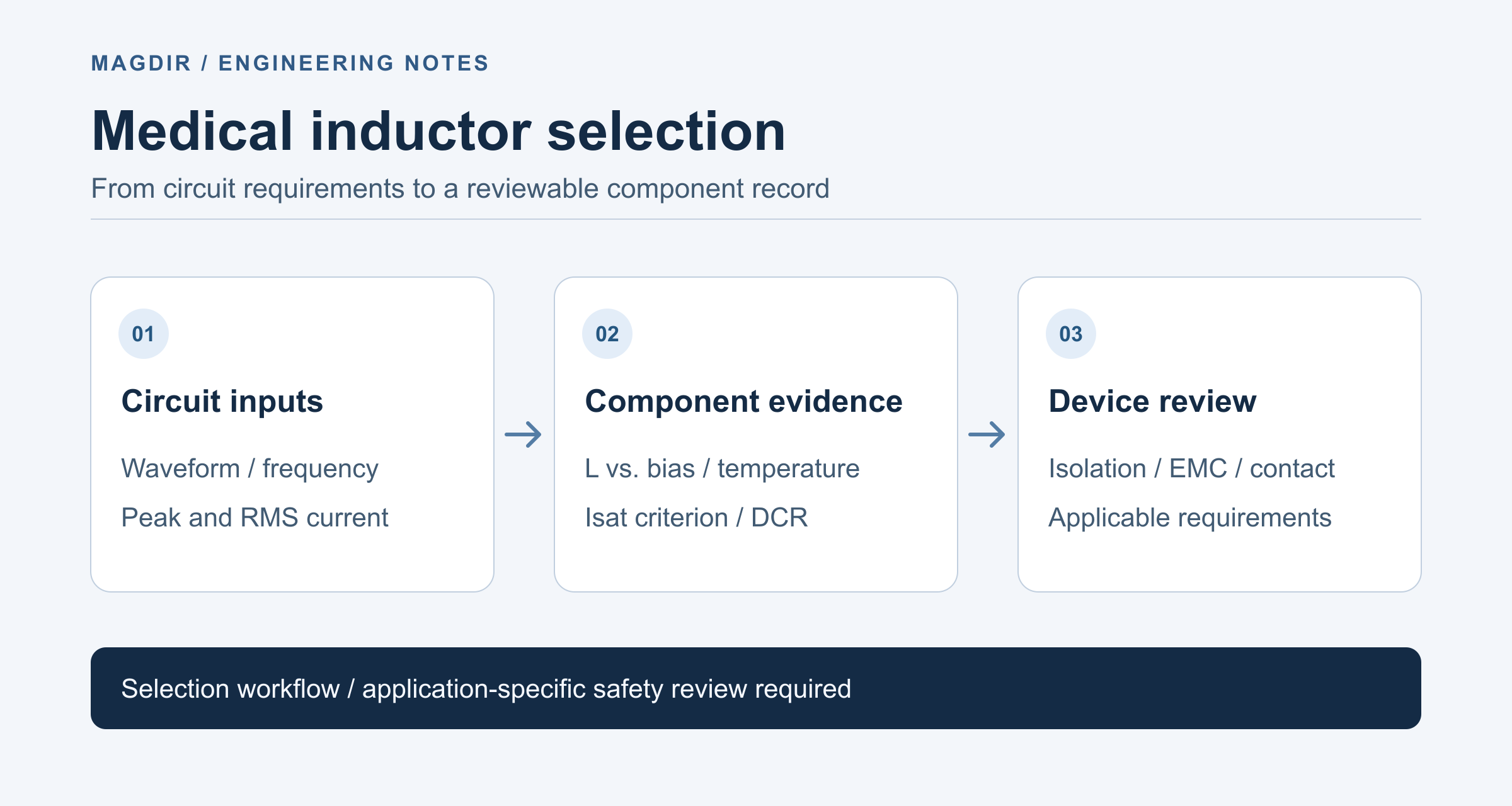
Record the circuit topology, switching frequency, voltage waveform, peak and RMS currents, DC bias, expected temperature, footprint and allowable parameter variation. For sensitive measurement circuits, include the interference that could affect the measurement and how that effect will be checked in the assembled equipment.
Keep equipment standards, risk management and supplier systems separate
The following references identify different subjects; they are not a list of certifications required of every inductor. Only their public scope descriptions were checked here, not every clause or national adoption.
| Reference | Subject to establish in the review |
|---|---|
| IEC 60601-1:2005+AMD1:2012+AMD2:2020, Ed. 3.2 | Equipment safety and essential performance; applicable particular standards also matter. |
| IEC 60601-1-2:2014+AMD1:2020, Ed. 4.1 | Equipment response to electromagnetic disturbances in its intended environment. |
| ISO 14971:2019 | Medical-device risk management. |
| ISO 13485:2016 | The organization's quality management system. |
FDA's 510(k) explanation, “Who is Required to Submit” distinguishes component manufacturers from finished-device manufacturers, with an exception for components promoted to end users as replacement parts. It does not establish “FDA-certified inductors.”
Calculate current stress without confusing Isat and Irms
Isat is tied to a specified drop in inductance. A manufacturer's Irms rating comes from stated temperature-rise test conditions; it is not an unconditional guarantee for any waveform or board. Coilcraft defines its Irms using a DC temperature-rise test. See its current and temperature ratings, especially the current-rating definitions and saturation-current section.
For a continuous current with triangular ripple, the following is a calculation example, not measured data. Assume a DC component of 2 A, peak-to-peak ripple of 0.6 A and winding DCR of 0.080 Ω at the operating condition being evaluated:
I_peak = I_DC + ΔI_pp / 2 = 2.30 A
I_RMS = √(I_DC² + ΔI_pp² / 12) ≈ 2.007 A
P_R = I_RMS² × DCR = 4.03 × 0.080 = 0.3224 W
The peak-current result helps identify which biased-inductance data to examine. The resistive-loss estimate excludes additional AC winding and core losses and does not predict temperature rise. Check startup, load transients and fault behavior separately; a controller's protection behavior cannot be inferred from the inductor's nominal current rating.
Evaluate isolation, interference and body contact in context
Do not adopt a universal withstand voltage or leakage-current limit from a component article. The safety review must establish the insulation function, relevant working and transient voltages, construction and equipment test conditions. A dielectric test result alone does not settle all of those questions.
Likewise, shielding or a choke impedance curve is only part of an EMC assessment. Define the noise path, installation and pass/fail criteria, then test the equipment configuration. Avoid declaring a fixed insertion loss or shielding benefit without its frequency, circuit and measurement conditions.
For materials, identify actual direct or indirect body contact rather than assuming every internal component needs the same biological tests. FDA's biocompatibility assessment basics, “What the FDA Assesses or Evaluates,” makes that distinction. A magnetic material's name alone cannot establish the safety of an encapsulated or implanted assembly.
Build a reviewable component record
- Identify the full part number, drawing and datasheet revision, supplier and change-notification arrangements.
- Compare inductance and tolerance at the relevant frequency, DC bias and temperature; record the Isat criterion and Irms test setup.
- Separate calculations from board measurements. Preserve waveforms, fixtures, instrument settings, ambient conditions and the populated-board configuration.
- Assess open circuit, short circuit and parameter drift in the equipment's risk analysis; document the evidence for each proposed control.
- Have the responsible specialists review applicable standards, patient connections, biological evaluation where relevant and final acceptance. Leave unresolved decisions open.
Use the inductor current check for preliminary calculations and the datasheet directory to locate candidate information. Neither replaces the evidence above or a device-level safety assessment.
References and revision
The linked IEC and ISO pages establish scope and the cited editions; FDA pages clarify component and contact distinctions; Coilcraft explains its rating methods. No certificate, prototype result or independent expert review is asserted.
Revised 2026-10-25: removed unsupported blanket certification claims and numerical safety limits, separated component selection from device compliance, and added a reproducible example. AI-assisted editorial review only; specialist safety and regulatory review remains required. The original URL and publication date are retained in the editorial record.